What Nine Hours in the ER Taught Me About Customer Support
You ever sit somewhere so long you start learning the shift schedule?
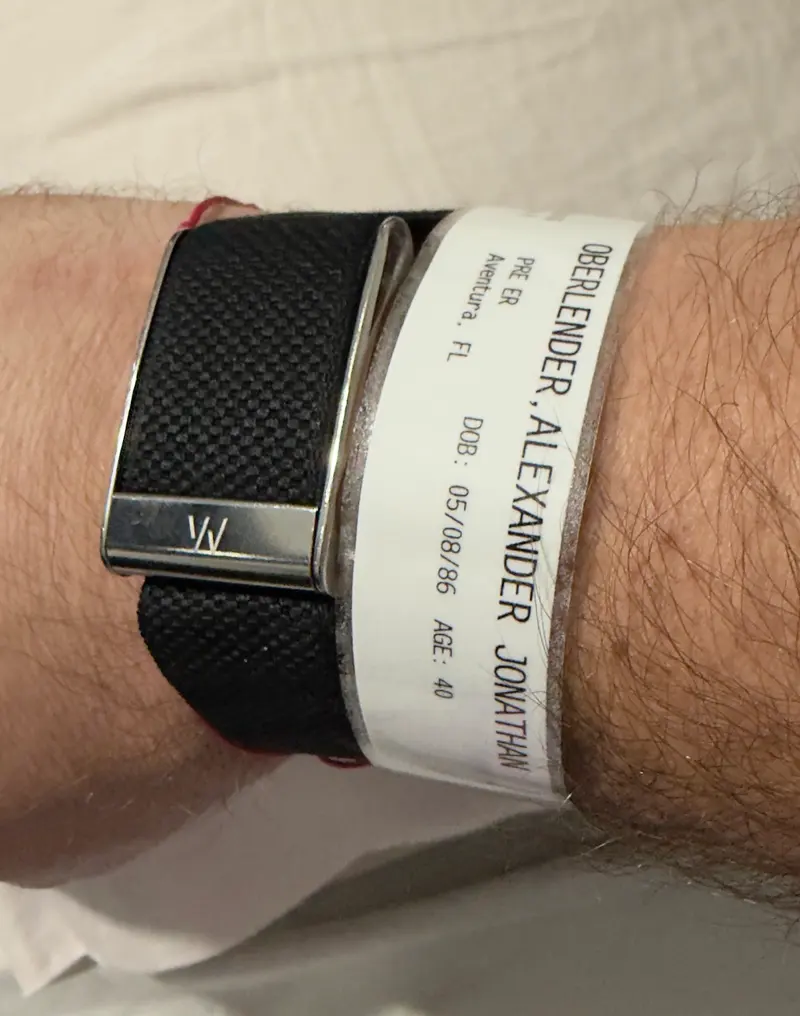
That was me this week. Nine hours in the emergency room.
I was having abdominal pain, and since I’ve had diverticulitis before, I know that feeling. You don’t wait it out and hope. You go get checked early, before “a little uncomfortable” turns into a five-day hospital stay.
So I went. And I waited. And waited.
Thankfully, I caught it early enough, and I just need to rest and take antibiotics.
Before anything else: the people were wonderful. Every nurse, every tech, every doctor who came into that waiting room was kind. Patient. Sweet, even. Nobody was rude to me once in nine hours, and I’ve had worse service ordering a sandwich.
They were also completely underwater.
And somewhere around hour six, I realized I’d spent my whole career watching this exact thing happen in customer support.
Nice people can’t out-work a broken flow.
Why Does the ER Take So Long?
The ER takes so long because patients are seen by how urgent their condition is, not when they arrived, and every step (labs, imaging, results, the doctor’s review) is its own separate line.
That’s not a complaint. Triage is the right call. If someone comes in with chest pain, they should go ahead of me and my stomach, every time.
But from the waiting room, you don’t see any of that.
And I never made it past the waiting room. At Aventura Hospital, that basically meant the lobby. Rows of chairs. Some people hooked up to IVs, some falling asleep sitting up, everybody watching the same door and waiting for their name. Every so often someone got called back for a test, and a few minutes later, back they came to wait some more. (Me included.)
You don’t know if you’re waiting on a lab, a radiologist, or a doctor who’s handling three emergencies at once. Nobody’s hiding anything. There’s just no one free to tell you.
The Tracker That Stopped Tracking
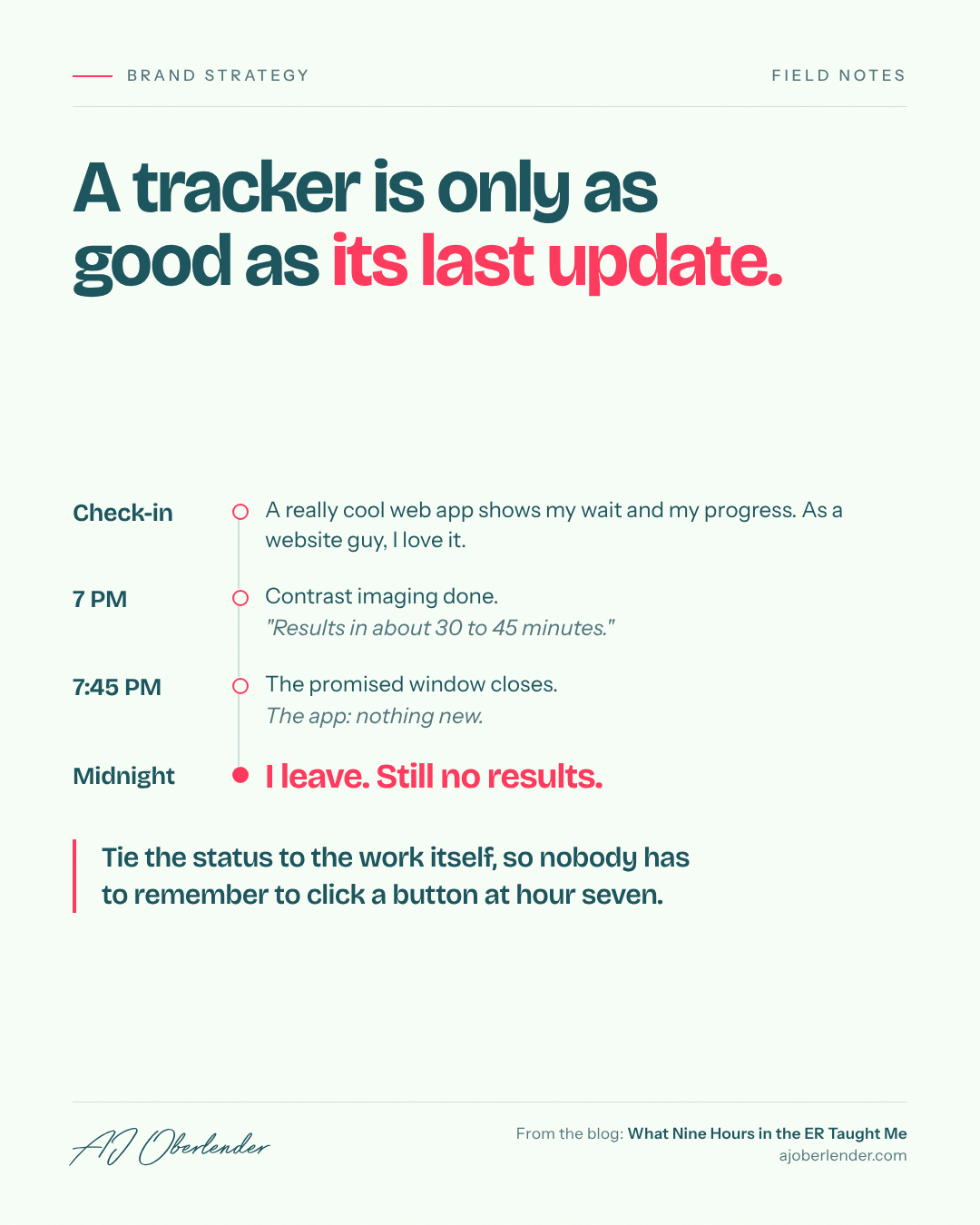
Here’s the part I didn’t expect. Aventura has a really cool web app that shows your wait time and where you are in the process. As a nerd who loves seeing new tech, I loved it. For a while.
Around 7 PM, I got contrast imaging done. They told me results would take about 30 to 45 minutes. By the time I left, close to midnight, the app still didn’t show any results, even though I got my results in my discharge forms and they’re in my health records app from them.
The app wasn’t broken. It just hadn’t been updated. And in an ER that slammed, nobody had a spare minute to click a button that says “results are in.”
A status tracker is only as good as its last update.
A tracker that stops moving can feel worse than no tracker at all. It made a promise. “We’ll show you where you are.” Then it went quiet, and you’re left refreshing a screen that’s telling you nothing new.
And that’s the part that stuck with me. The wait wasn’t the worst part. Not knowing was.
Your Support Team Has a Waiting Room Too
If you run customer support, operations, or honestly any team that serves people, you have an ER. It’s your ticket queue. Your inbox. The “we’ll get back to you within 24 to 48 business hours” auto-reply.
And I’d bet your front line looks a lot like those nurses. Good people. Doing their best. Absorbing frustration that isn’t about them, because it’s really about the system they’re stuck inside.
I see this constantly at DoorLoop. A huge part of my job isn’t building websites at all; it’s managing the anxiety of business owners waiting on one. I wrote about that in People Think They’re Buying a Website, and the ER made it painfully clear (pun intended) how right that was.
When someone emails “any update?” for the third time, they’re not being difficult. They’re the person in the waiting room chair, watching the door, wondering if anybody remembers they’re there.
The Psychology of Waiting (Somebody Already Figured This Out)
Back in 1985, a consultant named David Maister wrote a short paper called The Psychology of Waiting Lines. It’s still one of the most useful things I’ve ever read about customer experience, and it’s about lines.
A few of his big ideas, which I now understand on a very personal, nine-hour level:
- Uncertain waits feel longer than known waits. “Soon” is torture. “About 40 minutes” is fine.
- Unexplained waits feel longer than explained waits. Even a reason that doesn’t fix anything makes the wait easier.
- Anxious waits feel longer. When you’re worried about the outcome, every minute stretches.
Now picture an ER. Uncertain, unexplained, and anxious. All three at once. It’s the perfect storm of feeling forgotten.
Now think about your support queue. Is it any different?
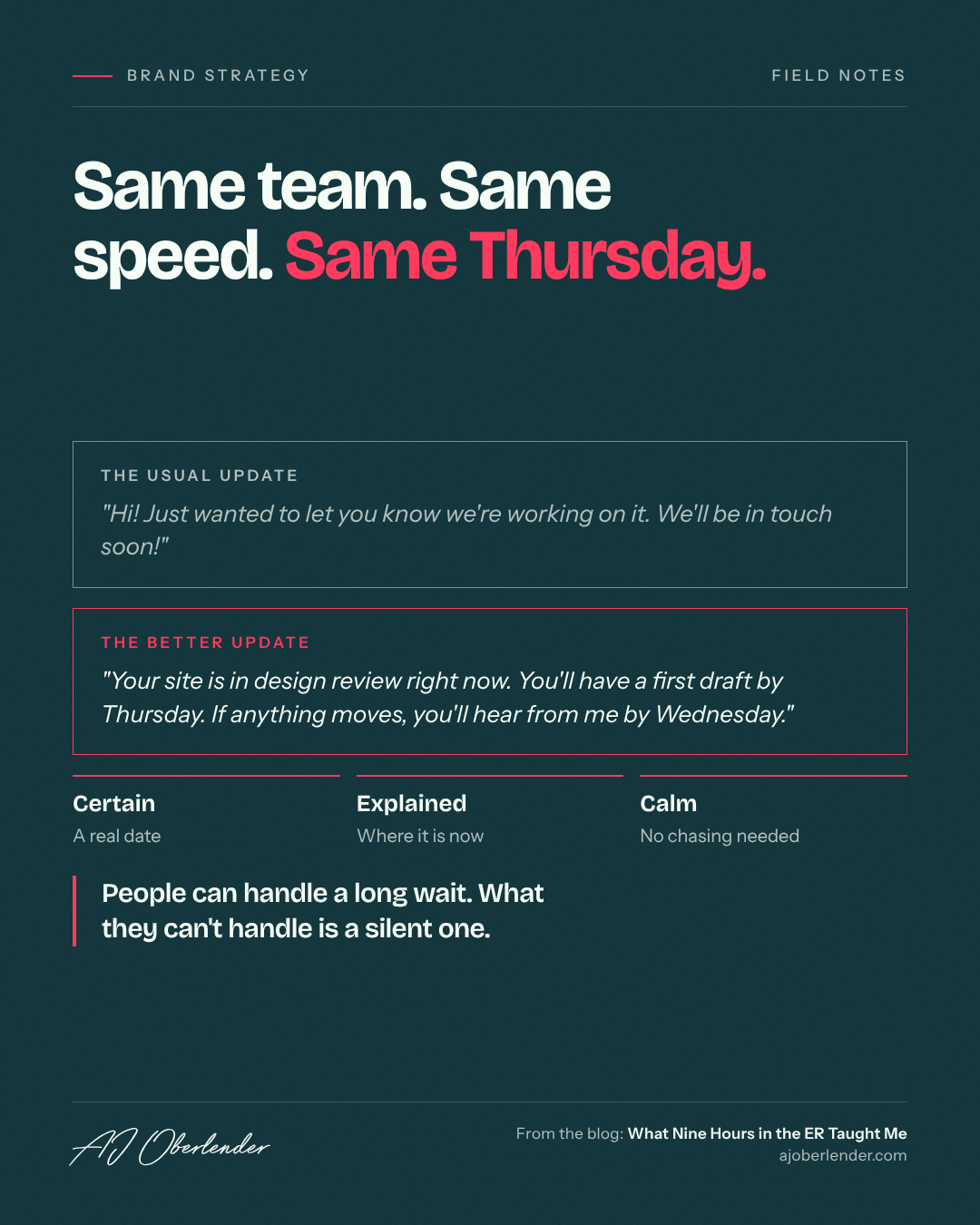
People can handle a long wait. What they can’t handle is a silent one.
Five Fixes That Don’t Require More Staff
Most companies try to fix wait times by hiring, or by telling the team to “move faster.” Sometimes you do need more people. But a lot of the pain in a wait has nothing to do with speed, and you can fix it this week.
- Give a real number, even a rough one. “We’ll have this to you by Thursday” beats “we’re working on it” every time. If the number changes, say so before the deadline, not after.
- Explain the wait. “Your site’s in design review” or “we’re waiting on your logo files” turns a black box into a process. People relax when they can see the machine.
- Send the update nobody asked for. One short “still on it, here’s where we are” message cuts the “any update?” emails in half (and those emails are what’s drowning your team in the first place).
- Automate the status, then keep it honest. Think about the Domino’s pizza tracker. Nobody needs a person to tell them the pizza’s in the oven. But Aventura showed me the catch: if a human has to remember to update the tracker, the tracker dies the minute the humans get busy. Tie the status to the work itself (the scan finishes, the result posts, the bar moves), so nobody has to click anything at hour seven.
- Watch your front line for burnout. The nurse who’s still kind at hour ten is a hero. That nurse is also a warning sign. If your best people are covering for the system with sheer niceness, the system is borrowing against them.
Want to see how small the fix can be? Here’s the same update, written two ways.
The usual version: “Hi! Just wanted to let you know we’re working on it. We’ll be in touch soon!”
The better version: “Your site is in design review right now. You’ll have a first draft by Thursday. If anything moves, you’ll hear from me by Wednesday, so you’re never wondering.”
Same team. Same speed. Same Thursday. But the second one answers all three of Maister’s problems in three sentences: it’s certain, it’s explained, and it lowers the anxiety. The first one just says “soon,” which, as we’ve established, is the scariest word in a waiting room.
It’s the same reason round three of revisions is almost never about the design. When people don’t know where they stand, they start asking for changes just to feel like something is moving.
Kindness Is Not a Strategy (But It’s the Point)
I want to be fair here. Hospitals are wildly more complicated than a website queue, and I’m not about to tell an ER how to run. The people I met were doing heroic work with what they had.
But that’s the lesson. You can hire the nicest people in the world. If they’re stuck in a flow that hides the wait from the customer, the customer will still walk out remembering the wait.
That’s what Unreasonable Hospitality gets right, too: the warmth only lands when the operation underneath it is working. Kindness keeps people from leaving angry. A good system keeps them from getting anxious in the first place. You need both.
And if you’ve had diverticulitis before and that familiar pain shows up? Go get checked. Even if it takes nine hours. I’ve got two little girls at home, and catching it early is part of the job (even when the job includes a very long day of staring at a door).
What’s the longest you’ve waited somewhere with zero updates? Tell me on LinkedIn. I’m guessing a few of you will beat nine hours.