What 'Am I My Brother's Keeper' Means, and Why Cain Ducked It
You’ve probably said “I’m not my brother’s keeper” at least once. Usually right before doing the thing anyway.
I know I have. It’s the sentence we reach for when something lands on our desk that isn’t technically ours. The broken process on another team. The neighbor’s trash can rolling down the street. The new hire nobody’s checking on.
It sounds like a boundary. It sounds healthy, even. Therapists would probably sign off on it.
Here’s the thing, though. The first person to say it was standing over a body.
This Shabbat, October 10, Jews everywhere start the Torah over again with Parashat Bereshit, and four chapters in we get the line. It’s one of the most quoted sentences in the Bible, and I think most of us have it backwards.
So What Does “Am I My Brother’s Keeper” Mean?
“Am I my brother’s keeper?” is Cain’s answer to God in Genesis 4:9, a dodge he uses to deflect responsibility after he’s killed his brother Abel.
That’s the plain answer. The verse goes like this: God asks Cain, “Where is your brother Abel?” And Cain says, “I do not know. Am I my brother’s keeper?”
Two lies in nine words. He knows exactly where Abel is. And the question isn’t a question; it’s a shrug with a question mark on it.
The Hebrew is even sharper. Hashomer achi anochi, literally “Am I the guard of my brother?” A shomer is a watchman, a guard, the person whose whole job is to keep an eye on something. Cain’s saying, essentially, “That’s not my department.”
(Every office in America has a guy who’s said that exact sentence. Usually about the printer.)
The Oldest Deflection in the Book
What gets me is that God never answers the question.
Not with a yes. Not with a no. There’s no lecture about what a brother owes a brother. God skips Cain’s question completely and goes straight to the facts: “What have you done? Your brother’s blood cries out to Me from the ground!” (Genesis 4:10).
I read that as God saying, “We’re not going to debate the org chart right now.”
Because that’s what Cain’s line really is. It’s a debate about scope, offered at the exact moment when scope doesn’t matter anymore.
That feels like the move most of us make when we’re caught. We don’t deny the thing. We argue about whether the thing was ours to care about.
And it’s not like Cain wasn’t warned. A few verses earlier, before anything happens, God sees him sulking and tells him that sin is crouching at the door, “yet you can be its master” (Genesis 4:7). The responsibility conversation started before the crime, not after. Cain just wasn’t listening yet. (Relatable, if you’ve ever been told twice to back up a hard drive.)
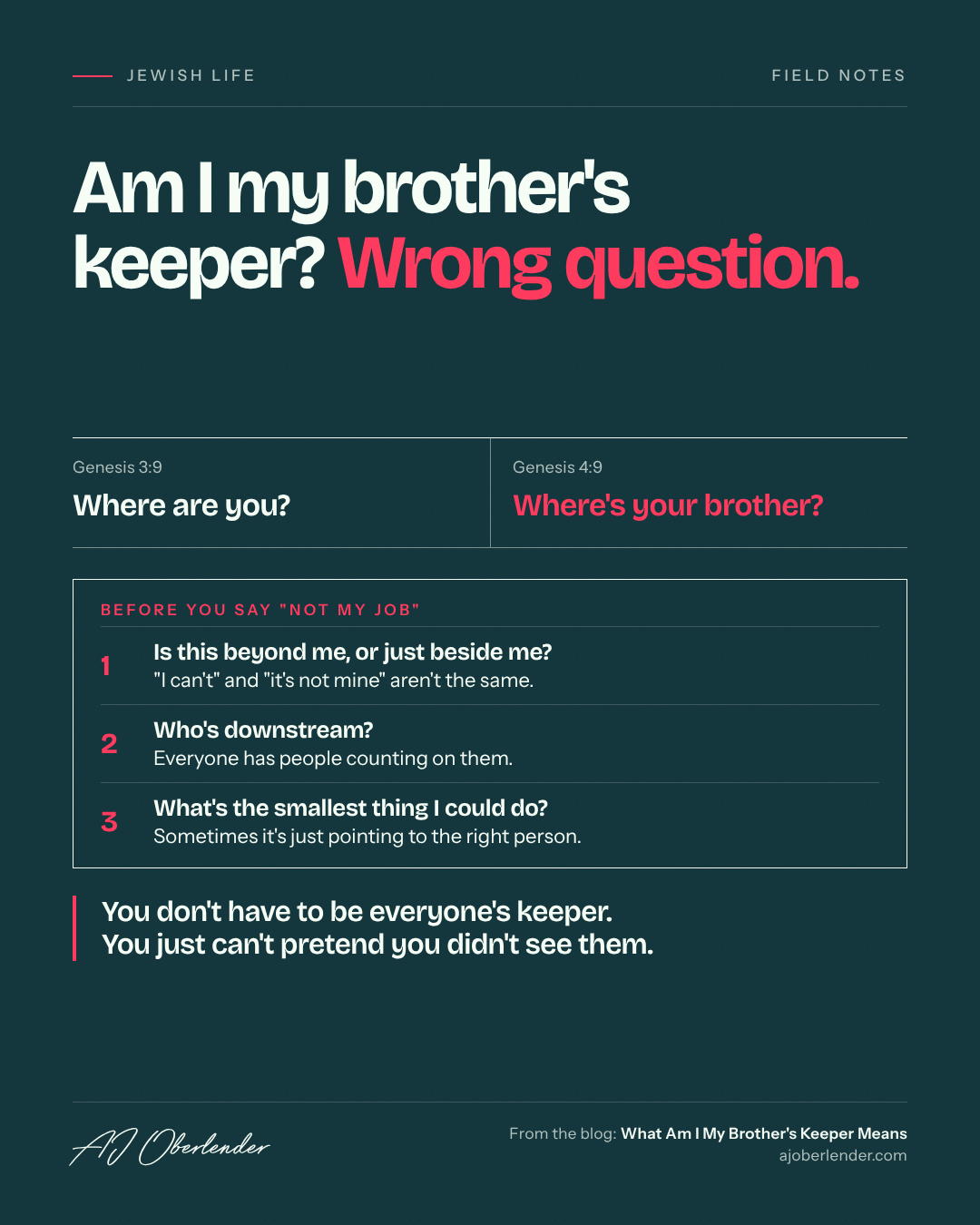
There’s another detail I love here. One chapter earlier, God asks Adam a question too: “Where are you?” (Genesis 3:9). In Hebrew, Ayekah. Adam’s hiding behind a tree, and God wants to know where he is.
With Cain, the question changes. Not “where are you?” but “where is your brother?”
So the first two questions God asks people in the whole Torah are:
- Where are you?
- Where’s the person next to you?
That’s the entire job description of being a grown-up, and we got it in the first four chapters.
The Mishnah Reads One Word Very Closely
Jewish tradition doesn’t let this verse off easy. The rabbis of the Mishnah noticed something odd about the Hebrew in verse 10. God doesn’t say “your brother’s blood” in the singular. The word is demei, plural. Your brother’s bloods.
Mishnah Sanhedrin 4:5 explains why: it’s Abel’s blood and the blood of every descendant he never got to have. Cain didn’t end one life. He ended a family tree.
That same Mishnah is where we get the famous line that whoever sustains one soul is treated as if they’ve sustained an entire world. And it adds something I think about a lot as a dad: every person is obligated to say, “The world was created for me.”
Read those two ideas together and you get a pretty demanding picture. Your choices ripple. Your neglect ripples too. The person you didn’t check on has people downstream of them.
Cain thought he was answering for one brother. The Torah says he was answering for a whole world.
The Org Chart Says No. The Torah Says Keep Going.
Look, I’m not here to tell you to adopt every problem in your building. That’s a fast track to burnout, and I’ve written about the shamash candle for exactly that reason: the helper candle lights the others without melting itself down to nothing.
But there’s a difference between “I can’t fix this” and “this isn’t mine.” The first one is honest. The second one is Cain.
At DoorLoop, I’m team of one. When you’re a team of one, there’s no “that’s not my department.” Everything’s your department. The customer whose site launch slipped because of a billing hiccup on another team? Technically not my problem. Practically, they’re my customer, and they don’t care which Slack channel the hiccup lives in.
Sometimes the right answer is waiving a fee for someone who needs a win, even when the policy says I don’t have to. Policy is the org chart. The person on the Zoom call is the brother.
And it cuts both ways. The best leaders I’ve worked with never said “not my job” out loud. I wrote about a COO assembling desks a while back. Nobody asked him to. He just didn’t think of the new office as somebody else’s problem.
So the next time “I’m not my brother’s keeper” is on the tip of your tongue, run it through three questions first. It takes about ten seconds:
- Is this beyond me, or just beside me? “I can’t” and “it’s not mine” feel the same in the moment. They aren’t.
- Who’s downstream? Remember the plural bloods. The person in front of you has a team, a family, customers of their own.
- What’s the smallest thing I could do? You don’t have to own it. You might just have to point it to the right person, out loud, today.
Most of the time the answer is a lot smaller than taking over. It’s just not walking past it.
You don’t have to be everyone’s keeper. You just can’t pretend you didn’t see them.
What I Want Yael and Diana to Hear
Yael and Diana are at the age where “that’s not mine” is basically a legal defense. Toys on the floor? Not mine. Juice on the couch? Somebody else did it. (If you live with a three-year-old, you know “somebody else” is a very busy person.)
If I have to argue for someone to clean up the toys, so that Mazi doesn’t have to deal with it, one more time I may lose my patience.
I don’t expect them to read and understand Genesis 4 anytime soon. But I want them to grow up knowing that the very first question in the Torah about other people is “where is your brother?” and that the right answer is never a shrug.
I want them to be the kid who notices the other kid sitting alone. The coworker who says, “Hey, did anyone follow up with her?” The adult who answers “where’s your brother?” with an actual location.
That’s not a heavy burden. It’s just a habit. And habits start at home, usually at the dinner table, usually with juice on the couch.
Shabbat shalom from Miami. This week, when we read Bereshit, I’m going to listen for that question a little differently.
Who’s someone in your life who never once said “not my job”? Tell me about them on LinkedIn. I’d love to give them a shout-out.